



Buying a property is one of the most significant financial decisions you’ll ever make, and understanding the government’s valuation system is just as important as selecting the right location. In Gujarat, the Jantri Rate acts as the official benchmark for determining the minimum value of land and property transactions. Whether you are purchasing your first apartment, investing in commercial property, or selling real estate, knowing the latest Jantri Rate Gujarat 2026 can help you make informed financial and legal decisions.
Ahmedabad’s real estate market continues to evolve with metro expansion, infrastructure improvements, and growing residential demand. As property values rise across the city, understanding Jantri Rates becomes essential for estimating stamp duty, registration charges, and the actual cost of property ownership.
Understanding the Jantri Rate and Its Importance
A Jantri Rate is the minimum property value determined by the Government of Gujarat for different locations. It serves as the official benchmark for calculating stamp duty and registration charges during property transactions.
Unlike the market price, which is negotiated between buyers and sellers, the Jantri Rate is fixed by the government after evaluating several factors, including infrastructure, accessibility, road width, land use, and the overall development of a locality.
For buyers, this system promotes transparency during property registration. For the government, it helps ensure fair tax collection and discourages the undervaluation of properties.
How Jantri Rates Influence Ahmedabad’s Property Market?

Ahmedabad has experienced remarkable urban growth over the last decade. Localities such as SG Highway, Science City, Shela, South Bopal, Gota, Thaltej, and Vaishnodevi have witnessed increasing residential and commercial demand due to improved infrastructure and better connectivity.
As these areas continue developing, Jantri Rates are periodically revised to reflect changing market conditions. Although the government valuation may still be lower than the actual market price in several premium neighbourhoods, revised Jantri Rates often indicate an area’s long-term growth potential.
Understanding these values helps buyers estimate registration costs before completing a transaction and evaluate whether a property’s asking price aligns with the locality’s overall market trend.
What’s New in Jantri Rate Gujarat 2026?
The Jantri Rate Gujarat 2026 reflects Ahmedabad’s continuous infrastructure development and urban expansion. Improved metro connectivity, smart roads, commercial developments, and new residential townships have contributed to revised government property valuations in several parts of the city.
Rather than focusing solely on today’s property prices, buyers should also consider upcoming infrastructure projects that may influence future appreciation. Areas benefiting from public investments often witness gradual increases in government valuation as development progresses, making them some of the best places to invest in Ahmedabad.
Jantri Rate Gujarat 2026: Key Highlights
- Government-approved minimum property valuation.
- Used to calculate stamp duty and registration charges.
- Different rates apply to residential, commercial, industrial, and agricultural properties.
- Rates vary depending on locality, road width, land use, and development.
- Updated periodically based on urban growth and market trends.
Area-Wise Property Trends Across Ahmedabad
Although Jantri Rates differ depending on survey numbers, zoning, and property characteristics, the following locations continue to attract strong buyer interest due to their infrastructure and future growth prospects.
| Area | Residential Demand | Investment Potential |
|---|---|---|
| SG Highway | Very High | Excellent |
| Thaltej | High | Strong |
| Science City | High | Excellent |
| South Bopal | High | Excellent |
| Shela | High | Strong |
| Gota | Medium-High | Good |
| Vaishnodevi | High | Strong |
| Motera | High | Excellent |
| Chandkheda | Medium-High | Good |
| Nikol | Medium | Moderate |
Jantri Rate vs Market Rate: Understanding the Difference

Many first-time homebuyers assume that the Jantri Rate and market rate are the same, but they serve entirely different purposes.
Jantri Rate
The Jantri Rate is the minimum property valuation determined by the Government of Gujarat. It is primarily used for calculating stamp duty and registration charges during property transactions.
Market Rate
The market rate is the actual price agreed upon between the buyer and seller. It depends on factors such as location, project quality, amenities, builder reputation, infrastructure, and market demand.
In premium areas like Science City, SG Highway, and Thaltej, the market price is often considerably higher than the government-prescribed Jantri Rate.
Stamp Duty & Registration Charges in Gujarat
Stamp duty is calculated on either the Jantri Rate or the actual transaction value, whichever is higher. Registration charges are payable separately at the time of property registration.
These charges form an important part of the total cost of purchasing property, making it essential for buyers to estimate them before finalising a deal.
Stamp Duty Benefits for Women
To encourage property ownership among women, the Gujarat Government may offer stamp duty concessions for eligible female buyers under applicable policies. Buyers should always verify the latest government guidelines before registration.
How to Check Jantri Rate in Ahmedabad Online
The Gujarat Government provides an official online portal where property buyers can verify Jantri Rates for different locations across the state.
The process generally involves selecting the district, taluka, village or ward, survey number, and property type. Once these details are entered, the portal displays the applicable government valuation for the selected property.
Checking the official Jantri Rate before purchasing a property helps buyers estimate registration costs, compare property values, and avoid unexpected financial surprises.
How to Calculate Property Value Using the Jantri Rate
Knowing how to calculate property value using the Jantri Rate helps buyers estimate the government’s minimum valuation before completing a transaction.
The basic formula is:
Property Value = Jantri Rate × Total Property Area
For example, if the Jantri Rate for a residential plot is ₹30,000 per square metre and the plot size is 120 square metres, the government valuation would be:
₹30,000 × 120 = ₹36,00,000
It’s important to remember that the actual selling price may be higher than the Jantri valuation. If the transaction value exceeds the Jantri Rate, stamp duty is generally calculated on the higher amount.
Before purchasing any property, buyers should verify the latest Jantri Rate through the official Gujarat Government portal or consult a qualified real estate professional to ensure accurate calculations.
Factors That Affect Jantri Rates in Ahmedabad
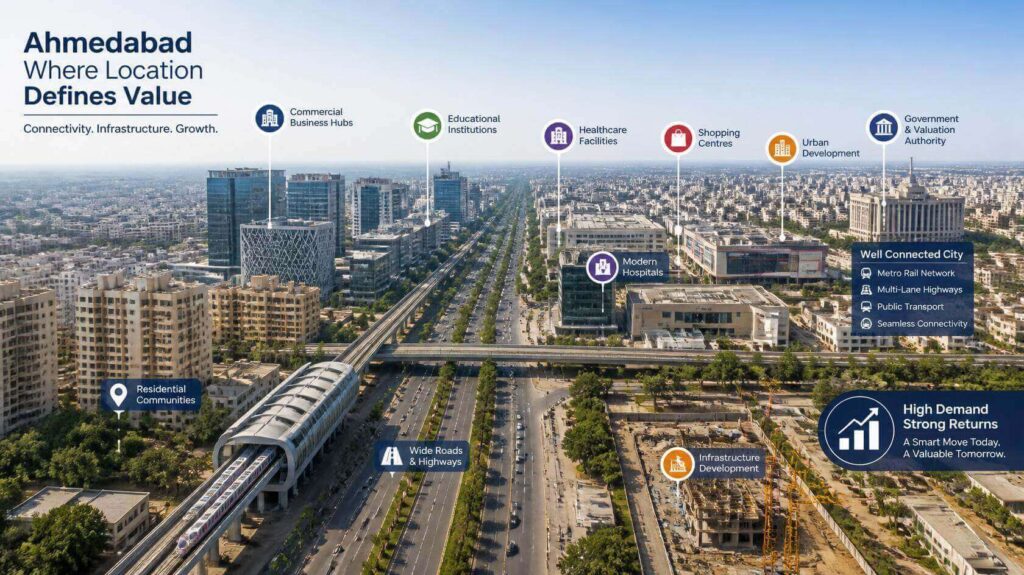
Jantri Rates are determined after evaluating multiple aspects of a property’s location and development potential. As Ahmedabad continues expanding, these factors play an important role in government valuation updates.
Some of the key factors include:
- Infrastructure development and road improvements
- Metro connectivity and public transport access
- Location and proximity to commercial hubs
- Residential and commercial demand
- Availability of schools, hospitals, and shopping centres
- Land use classification
- Smart City and urban development initiatives
- Road width and property accessibility
- Future government infrastructure projects
Understanding these factors allows buyers to identify neighbourhoods with strong long-term growth potential rather than focusing solely on current market prices.
Why Every Property Buyer Should Review the Jantri Rate Before Investing
Checking the Jantri Rate before purchasing property provides both financial clarity and legal confidence. It allows buyers to understand the government’s valuation while planning the total investment cost more accurately.
Some of the key benefits include:
- Estimate stamp duty and registration expenses in advance.
- Compare the government’s valuation with the seller’s asking price.
- Avoid unexpected costs during property registration.
- Assess whether the quoted price is reasonable for the locality.
- Plan your property budget more effectively.
- Identify locations with long-term appreciation potential.
- Make informed investment decisions based on official property valuation.
- Reduce the chances of legal or documentation-related issues during registration.
Although the Jantri Rate should never be the only factor influencing a purchase decision, it remains an essential benchmark when evaluating any property investment.
Conclusion
The Jantri Rate Gujarat 2026 is much more than a government valuation; it is a valuable reference that helps buyers understand the financial aspects of property transactions. While the market price reflects demand and negotiation, the Jantri Rate establishes the minimum value considered for taxation and registration.
As Ahmedabad continues expanding through metro projects, smart infrastructure, and new residential developments, staying informed about Jantri Rates can help buyers make smarter investment decisions. Whether you’re purchasing your first home or building a long-term investment portfolio, combining Jantri Rate analysis with market research, legal verification, and location assessment will ensure a more confident and secure property purchase.
Frequently Asked Questions
The Jantri Rate is the minimum property valuation fixed by the Government of Gujarat for calculating stamp duty and registration charges during property transactions.
No. The Jantri Rate is the government-prescribed minimum valuation, whereas the market price is the amount agreed upon between the buyer and seller.
You can check the latest Jantri Rate through the official Gujarat Government Jantri portal by selecting the property’s location and survey details.
It helps estimate stamp duty and registration charges, compare government valuation with market price, and supports better financial planning before purchasing property.
The property value is calculated by multiplying the applicable Jantri Rate by the total property area. This valuation is used as the basis for calculating stamp duty and registration charges.
Infrastructure development, metro connectivity, location, road width, land use, commercial demand, social infrastructure, and government urban development projects all influence Jantri Rates.
Not necessarily. The Gujarat Government revises Jantri Rates periodically based on infrastructure growth, market trends, and urban development across different regions.
Yes. In many prime locations across Ahmedabad, the market value is significantly higher than the government-prescribed Jantri Rate due to strong demand, premium amenities, and superior connectivity.



Leave a Reply